
Phosphate-free laundry detergent without optical brighteners: what the labels mean

Laundry detergent packs often carry claims such as "phosphate-free", "no optical brighteners" and "dye-free". Some of them genuinely tell you something about the product; others only state what the law already requires. In this article, we explain what these substances do, why they're worth avoiding and how to read the label to understand what you're actually buying.
Phosphates: why they shouldn't be there any more
Phosphates used to be added to laundry detergents to soften water: they bind calcium and magnesium so the cleaning agents work better. The problem is that they end up in rivers and lakes with wastewater, where they encourage algae growth and cause bodies of water to become overgrown.
That's why the European Union has strictly restricted the phosphate content of household laundry detergents since 2013. So today, "phosphate-free" isn't a special advantage – it's the norm. It's not a bad sign, but it shouldn't be the only reason to choose one detergent over another.
Optical brighteners: white that only looks white
Optical brighteners aren't bleach in the usual sense. They are substances that stay on the fabric and turn ultraviolet light into a bluish glow. To the eye, the garment looks whiter and "brighter", even though the stain itself hasn't gone anywhere.
Why they're worth avoiding:
- They stay on your clothes. Brighteners are designed not to rinse out but to attach to the fibres, so they travel with your laundry onto your skin.
- They alter colours. Light-coloured and pastel garments can take on a greyish or bluish tint, and black clothes gradually look faded.
- They mask rather than clean. If a white shirt has yellowed from sweat, an optical brightener only hides it. It's better to actually break the stain down and wash it out.
You don't need brighteners to keep whites white: it's far more important to wash out sweat and skin oils in good time. We explain how in our article How to remove sweat stains from white shirts.
Dyes: colour for the detergent, not your clothes
A detergent's colour – blue, green or pink – is only there to make the product look nice in the bottle. It adds nothing to the wash. Without dyes, the formula is simpler and fewer unnecessary substances are left in the fabric.
How to read a laundry detergent label
EU rules require the main groups of ingredients to be listed on the pack. Look out for the following:
- Surfactants (anionic, non-ionic) – the main cleaning component; they're in every detergent.
- Enzymes – if present, the detergent removes sweat, food and grease stains better at lower temperatures.
- Optical brighteners – if you want to avoid them, this term shouldn't appear in the ingredients.
- Perfumes – if you're sensitive to scents, choose a subtler fragrance and don't overdose.
What the label doesn't say matters just as much: "natural" or "eco" on the pack guarantees nothing in itself. Read more in our article Eco laundry detergent: what it really means.
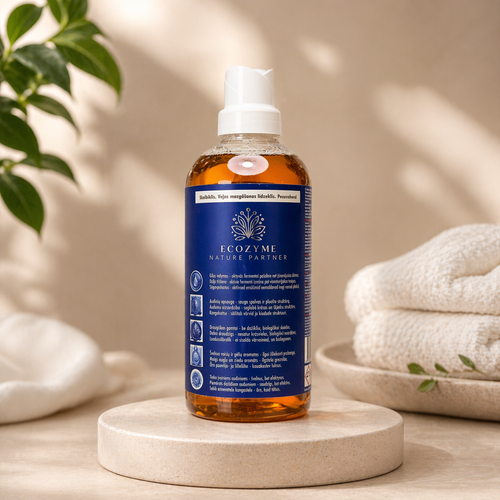
Ecozyme enzyme laundry detergent ingredients
Ecozyme enzyme laundry detergent contains no phosphates, no optical brighteners and no dyes. Its composition according to the label: 5–15 % anionic and 5–15 % non-ionic surfactants, less than 5 % soap, enzymes, preservative and perfumes. The detergent works at 30–60 °C, and 1 litre is enough for up to 33 washes.
Important: like all enzyme detergents, it isn't suitable for wool and silk. Undiluted, the detergent irritates skin and eyes, so keep it out of the reach of children.
Frequently asked questions
Won't whites turn grey without optical brighteners?
Whiteness depends mostly on whether sweat, grease and detergent residue are washed out in good time. Wash whites separately, don't overdose the detergent and don't overload the drum. You'll find more tips in our article on laundry detergent for whites.
Does a dye-free detergent wash less well?
No. Dyes are only there for the detergent's appearance; they play no part in the wash.
Does "phosphate-free" mean the detergent is eco-friendly?
Not really. Phosphates are restricted in the EU anyway, so on its own this claim says little about the product. Look at the full list of ingredients.
Summary
Today, "phosphate-free" is the EU norm, "no optical brighteners" is a real difference – especially if you care about colours and what stays on your clothes – and "dye-free" means a simpler formula without unnecessary additives. If you're looking for a detergent that washes stains out rather than masking them, try Ecozyme enzyme laundry detergent or browse the full laundry detergent collection.