
Enzyme vs regular laundry detergent: what's the difference and which to choose

On the shelf, both bottles look much the same: a liquid, a measuring cap, a promise about stains. But enzyme and regular laundry detergents remove stains in different ways, so the results differ – and so does the temperature it makes sense to wash at. In this article, we explain in plain terms how they differ, when an enzyme detergent really has the edge and when you don't need one.
In short: what's the difference?
Regular detergent mostly "washes away" dirt: surfactants lift soiling off the fabric, and heat and the machine's movement help rinse it out. Enzyme laundry detergent contains the same cleaning agents, plus enzymes that break the stain down into small particles. That's why it also works well when you don't use hot water.
| Regular detergent | Enzyme detergent | |
|---|---|---|
| How it removes stains | Lifts and washes away | Breaks down and washes away |
| Where it's strongest | Dirt, dust, higher temperatures | Sweat, food, grease, blood, grass |
| Suitable temperature | Often 40–60 °C | Works well from 30 °C |
| Wool and silk | Depends on the product | Not suitable |
How enzymes work
Enzymes are proteins that speed up specific chemical reactions. In a laundry detergent, each type of enzyme "recognises" its own kind of stain:
- Proteases break down protein stains: sweat, blood, egg, milk, grass.
- Lipases break down fats: oil, sauces, make-up, skin oils on collars.
- Amylases break down starch: potatoes, pasta, porridge, chocolate.
Once a stain has been broken down into small, water-soluble particles, it rinses out more easily, even on a shorter programme. We cover this in more detail in our article Enzyme laundry detergent: how it works and why it's worth choosing.
When an enzyme detergent really has the edge
Sweat and odours
Sportswear, T-shirts, bedding and towels absorb sweat and skin oils. If these aren't fully washed out, an odour stays in the fabric and comes back as soon as the garment warms up. Proteases and lipases break down exactly these residues, which is why an enzyme detergent usually makes the clearest difference here.
Food stains
Sauces, chocolate, porridge and grease are typical everyday stains, especially in families with children. It's worth applying detergent to them before washing and leaving it for 15–30 minutes, then washing as usual.
Washing at lower temperatures
If you usually wash at 30 or 40 °C, enzymes help you get good results without hot water. This is gentler on colours and fabrics, and washing at lower temperatures uses less electricity.
When a regular detergent is enough
- You only wash wool or silk – these need a special enzyme-free detergent.
- Your clothes are barely soiled and just need "freshening up" – then the difference is small.
- You often wash at 60 °C (e.g. workwear or bedding) – the heat does part of the job.
For most households these are exceptions rather than the everyday norm, so for everyday laundry it's usually more practical to have one good enzyme detergent.
Is enzyme detergent more expensive?
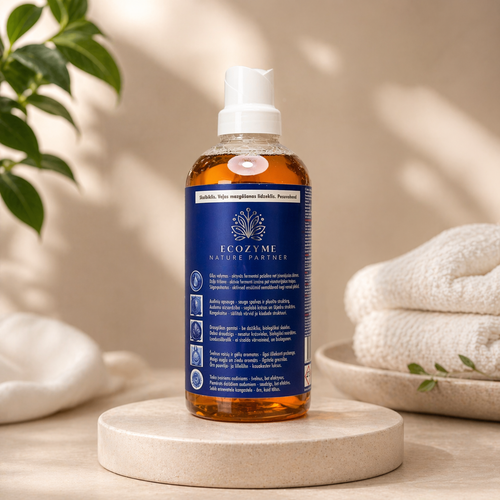
The pack often costs more, but what you should compare isn't the bottle – it's the cost per wash. A concentrated detergent lasts for more washes, and you don't need to overdose or wash things twice. For example, 1 litre of Ecozyme enzyme laundry detergent is enough for up to 33 washes, so one wash costs from €0.45. To learn how to work this out yourself, see our article Concentrated laundry detergent: how to calculate the cost per wash.
How to recognise a genuine enzyme detergent
- The ingredients list should include enzymes.
- The label should warn that the product is not suitable for wool and silk – a sign that the enzymes really are active.
- The instructions usually recommend a temperature of 30–60 °C.
Frequently asked questions
Is enzyme detergent suitable for coloured and dark clothes?
Yes, as long as it contains no optical brighteners. Ecozyme detergent doesn't contain any, so it's suitable for whites, colours and darks alike.
Can I wash by hand?
Yes. Ecozyme enzyme laundry detergent is suitable for both machine washing and hand washing. When washing by hand, rinse the garments well.
How much should I use?
One cap holds 40 ml. Use 40 ml for lightly soiled laundry, 50 ml for moderately soiled and 60 ml for heavily soiled laundry; in soft water, 10 ml less is enough. More in our detergent dosing guide.
Summary
Regular detergent mostly washes stains away; enzyme detergent also breaks them down. That makes enzyme detergent especially useful for sweat, food and grease stains and for washing at 30–40 °C. If you'd like to try it, Ecozyme enzyme laundry detergent is available as a one-time purchase or with a 30-day trial, and you'll find the full range in our laundry detergent collection.