
Laundry Detergent Without a Strong Scent: When Less Fragrance Is Better

Some people judge how clean their laundry is by its smell: the stronger the scent, the cleaner it seems. In reality, a strong fragrance does not necessarily mean the clothes have been washed more thoroughly. Sometimes the scent simply masks sweat, damp or detergent residue. That is why a softer, unobtrusive scent can be the better everyday choice, especially for bedding and sportswear. In this article we look at when a lighter scent really helps, where an overly strong fragrance in laundry comes from and how to adjust it.
Why can a strong scent be misleading?
A strong scent creates a sense of cleanliness, but it does not show whether body oils, sweat residue, food stains or deposits from the washing machine have been removed. If clothes start to smell bad again after a few hours, the problem is usually not a lack of fragrance but substances that were never washed out of the fabric.
In that case it is worth reading our guide to laundry detergent for sweat odour and checking that your programme is not too short.
Where does an overly strong scent in laundry come from?
How strong the scent is depends not only on the product itself but also on how you use it. The most common causes:
| Cause | What happens | How to reduce it |
|---|---|---|
| Too much detergent | The amount of fragrance rises with the dose, and some of the product stays in the fabric | Dose according to load size and soiling |
| Detergent and fabric softener together | The softener adds its own fragrance in the final rinse, and the scents build up in layers | Use softener only where it is needed, or use a smaller dose |
| Scent beads and scent boosters | An extra layer of fragrance with no cleaning effect | Skip them or use them rarely |
| A short or eco programme | Little water, so the product rinses out less well | Add an extra rinse |
| Drying in a small, unventilated room | The scent builds up in the air | Dry outdoors or ventilate the room |
Where is a softer scent most useful?
- Bedding. A strong scent can be bothersome at night, especially when the pillowcase is against your face. For how often and at what temperature to wash it, see our guide to washing bedding.
- Sportswear. Fragrance should not mask sweat residue; it is better to deal with the cause. More on this in our guide to washing sportswear.
- Kitchen towels and cloths. An intense fragrance does not go well with food and dishes.
- Clothes you wear with perfume. A strong laundry scent can compete with your perfume.
- Small flats. If you dry laundry indoors, the scent spreads through the whole space.
How do you get clean laundry without an intense scent?
Choose a detergent for what it does, not for how it smells. What matters most is how well it removes grease, sweat and stains; the scent is just an extra. In practice, that means:
- Pre-treat stains. Apply a little liquid detergent directly to the stain and leave it for about 10 minutes.
- Do not overload the drum. Laundry needs to move freely, otherwise some of the dirt and product stays in the fabric.
- Do not leave wet laundry sitting in the machine. Take it out as soon as the programme ends; otherwise a damp smell develops that you will later be tempted to cover up with fragrance.
- If the fabric smells too strongly of the product, reduce the dose or add an extra rinse.
For everyday laundry, a liquid detergent is a practical choice because it disperses quickly in water and is easy to dose.
How to control the scent if your detergent is fragranced
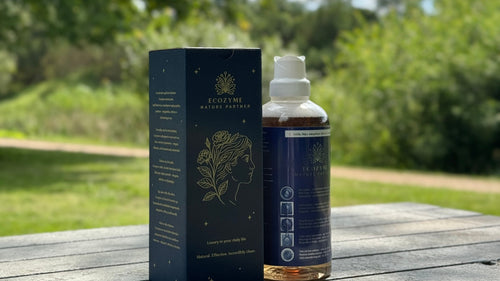
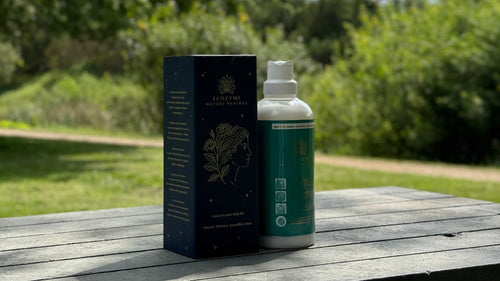
Most detergents contain fragrance, and that is not a bad thing in itself; for many people a pleasant scent is part of doing the laundry. What matters is that you control how strong it is. Ecozyme enzyme detergent, for example, is not unscented: its fragrance opens with a note of red apple, has peony, rose, carnation and jasmine at its heart and suede at its base. If you prefer a subtler result, a few simple habits are enough:
- Stick to the dose. For lightly soiled laundry, 40 ml of Ecozyme detergent is enough, or 30 ml in soft water.
- Use fabric softener deliberately. It adds extra, longer-lasting scent. If you want a lighter result, wash without it or use half the amount. Read more in our article Fabric softener: do you really need it?
- Match it to the laundry. It is better not to use softener on sportswear and towels, while casual clothes can keep a longer-lasting scent.
- Dry in fresh air. Laundry dried outdoors or in a well-ventilated room smells softer than laundry dried in a closed bathroom.
A common myth: "if it doesn't smell, it isn't clean"
Clean laundry does not have to smell strongly. It should have no bad smell, no stains and no sticky or slippery residue. That is a better measure of cleanliness than the intensity of the scent. You can check it like this:
- Smell the damp fabric straight after washing: it should not smell musty or sour.
- Once dry, the fabric should not feel sticky, slippery or stiff.
- The underarm and collar areas should not give off an odour when the garment warms up on your body.
- Towels should absorb water well.
If you are unsure about the amount of product, go back to the rules for dosing laundry detergent. Many problems are solved simply by cutting back an excessive dose.
Common mistakes
- Adding more detergent so the laundry "smells more".
- Masking sweat or damp odours with fragrance instead of removing the cause.
- Using fabric softener with every wash, even for sportswear.
- Mixing the scents of several different products in one wash.
- Leaving wet laundry in the drum overnight.
Frequently asked questions
Does a softer scent mean a weaker detergent?
No. Cleaning performance depends on the active ingredients, such as enzymes and surfactants, not on how strong the fragrance is. Scent is an added sensation, not an indicator of cleanliness.
Is Ecozyme detergent unscented?
No. Ecozyme enzyme detergent has a fruity-floral fragrance, the same as Ecozyme fabric softener. If you prefer a lighter scent, dose accurately according to the load and use the softener only when you want a longer-lasting fragrance.
Why do clothes smell nice after washing but start to smell of sweat again when worn?
The fragrance covered the odour, but greasy sweat residue stayed in the fibres, and body heat "wakes it up" again. What helps is a drum that is not overloaded, the right dose, pre-treating the underarm areas and a programme that is long enough.
What should I do if my laundry smells too strong?
Next time, reduce the detergent dose, skip the fabric softener or use half as much, and add an extra rinse. Clothes that have already been washed can be rinsed again in clean water with no product at all.
Summary
A strong fragrance is not proof of cleanliness, and sometimes it only hides dirt that has not been washed out. You can control the intensity of the scent yourself: accurate dosing, thoughtful use of fabric softener, an extra rinse and drying in fresh air give you clean laundry that smells pleasant but not overpowering.
What matters most for clean laundry is not the strength of the scent but whether the detergent removes dirt and rinses out well.